The question of how do AI detectors work has become central in education, SEO, and content moderation. As AI-generated text becomes more advanced, tools designed to identify it are evolving just as quickly. Today, most AI detection systems rely on machine learning models trained on datasets that often include millions of human and AI-written samples.
Despite their complexity, AI detectors do not “prove” authorship. Instead, they estimate the probability that a text was generated by artificial intelligence. This means that what is AI detection in practice is not a binary decision, but a statistical judgment based on patterns. Understanding how ai detectors work is essential if you plan to rely on them in professional or academic settings. Without that understanding, it is easy to misinterpret results and treat probability as certainty.
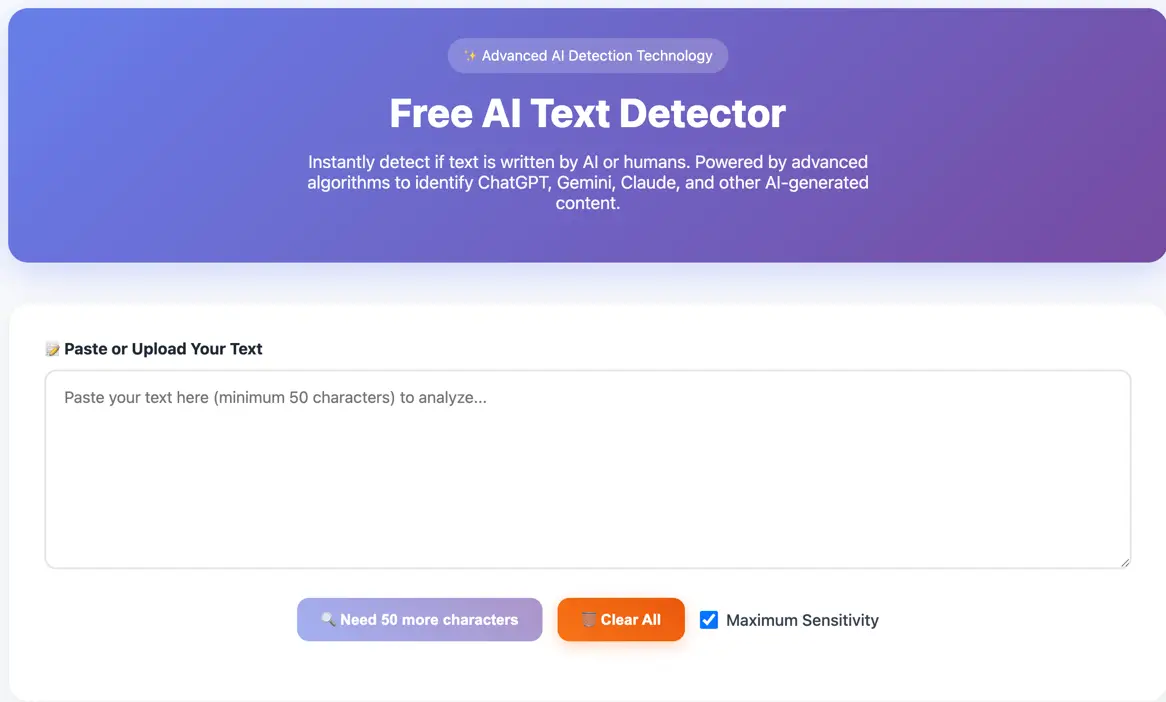
What Is AI Detection and What Is an AI Checker?
To understand how does AI detection work, it is important to define what is an ai checker. An AI checker is a tool that evaluates text and determines whether it resembles human writing or machine-generated output. Unlike plagiarism tools, it does not compare text to a database but instead analyzes writing patterns.
Most systems operate using probabilistic scoring. For example, a detector may indicate that a text is 75% likely to be AI-generated, rather than providing a definitive answer. These scores are based on linguistic signals rather than direct evidence.
This is why what is ai detection is fundamentally different from traditional verification methods. It is not about matching content, but about analyzing how the content behaves statistically.
How AI Detectors Work in Practice?
When asking how do ai checkers work, the process typically begins with breaking the text into smaller units called tokens. These tokens can represent words, subwords, or characters, and a single paragraph can contain hundreds of them. The system then converts these tokens into numerical representations that can be analyzed by machine learning models.
The detector evaluates how predictable each token is in relation to the others. AI-generated text tends to follow more predictable patterns because language models are designed to choose the most likely next word.
The final step is scoring. Most tools output a probability between 0% and 100%, representing how likely the text is AI-generated. Even highly advanced tools rarely exceed 80–85% accuracy in real-world testing, which highlights the limitations of this approach.
What Do AI Detectors Look For
When analyzing what do ai detectors look for, several key signals stand out. These signals are not visible to users but are calculated behind the scenes using statistical models.AI detectors primarily measure how predictable and uniform a piece of text is. One of the most important metrics is perplexity, which reflects how surprising or unpredictable the wording is. Lower perplexity often indicates AI-generated text because AI tends to choose the most probable word sequences.
Another critical factor is burstiness, which measures variation in sentence length and structure. Human writing typically shows more variation, while AI-generated text tends to be more consistent.Detectors may also analyze repetition patterns, tone consistency, and structural uniformity. These signals combined allow the system to estimate whether the writing resembles machine-generated output.
Methods Used in AI Detection
Some systems rely heavily on linguistic metrics such as perplexity and burstiness, while others use neural networks trained on large datasets. These models learn to distinguish between human and AI writing based on subtle differences in structure and style.AI detection is not based on a single method but rather a combination of techniques. Modern tools integrate statistical analysis, machine learning models, and pattern recognition to improve accuracy.
AI Detection Methods Overview
| Method | How It Works | Accuracy Level |
|---|---|---|
| Statistical Analysis | Measures predictability and variation (perplexity, burstiness) | Medium |
| Machine Learning Models | Trained on large datasets of human vs AI text | Medium–High |
| Hybrid Detection | Combines multiple models and signals | Higher but inconsistent |
| Pattern Recognition | Identifies repetition and structure patterns | Medium |
Reliability of AI Detection Tools
The biggest question is not how do ai detectors detect ai, but how reliable they actually are. Most tools claim high accuracy, often between 70% and 90%, but real-world performance varies depending on text length and complexity.
Short texts under 150–200 words are significantly harder to analyze, which reduces detection accuracy. At the same time, highly edited or paraphrased content can bypass detection systems entirely.
False positives are another major issue. In some cases, well-structured human writing is flagged as AI-generated simply because it appears too consistent. This creates risks in academic and professional environments where decisions rely on these tools.
Where AI Detection Breaks Down: Bias, Errors, and Legal Risks
AI detection systems often appear reliable on the surface, but their weaknesses become clear in real-world use. The biggest issue is that these tools operate on probability rather than certainty, which means they can fail in unpredictable ways. In practice, even a small shift in writing style or structure can significantly change the detection result.
One of the most visible failure points is false positives. Human-written content, especially when it is clear, structured, and grammatically consistent, can be flagged as AI-generated. This happens because many detectors associate “clean” writing with machine output, which creates a paradox where good writing increases the risk of being misclassified.
Bias is another major concern that is often underestimated. Studies and internal testing have shown that non-native English writers are disproportionately flagged as AI-generated. This happens because their writing may follow more predictable patterns or simplified structures, which resemble AI-generated text. As a result, AI detection systems can unintentionally penalize certain groups of users.
Another critical weakness is how easily detection can be bypassed. Even minor edits, such as paraphrasing or changing sentence length, can reduce detection accuracy by 20–50%. This makes it possible for AI-generated content to pass as human-written with minimal effort, while genuine human content may still be flagged incorrectly.These limitations become especially problematic when AI detection is used in high-stakes environments. In education, students may be accused of using AI without solid evidence. In hiring processes, candidates may be rejected based on unreliable scores. In content moderation, creators may face penalties despite producing original work.This leads directly to legal and ethical risks. Since AI detectors do not provide definitive proof, relying on them for disciplinary or contractual decisions can be challenged. Organizations that act solely on detection results may expose themselves to disputes, reputational damage, or even legal claims related to wrongful accusations or discrimination.
Ultimately, AI detection breaks down at the intersection of uncertainty, bias, and accountability. These tools can be useful as indicators, but they are not reliable enough to serve as final arbiters. The more critical the decision, the more dangerous it becomes to rely on them without human oversight.